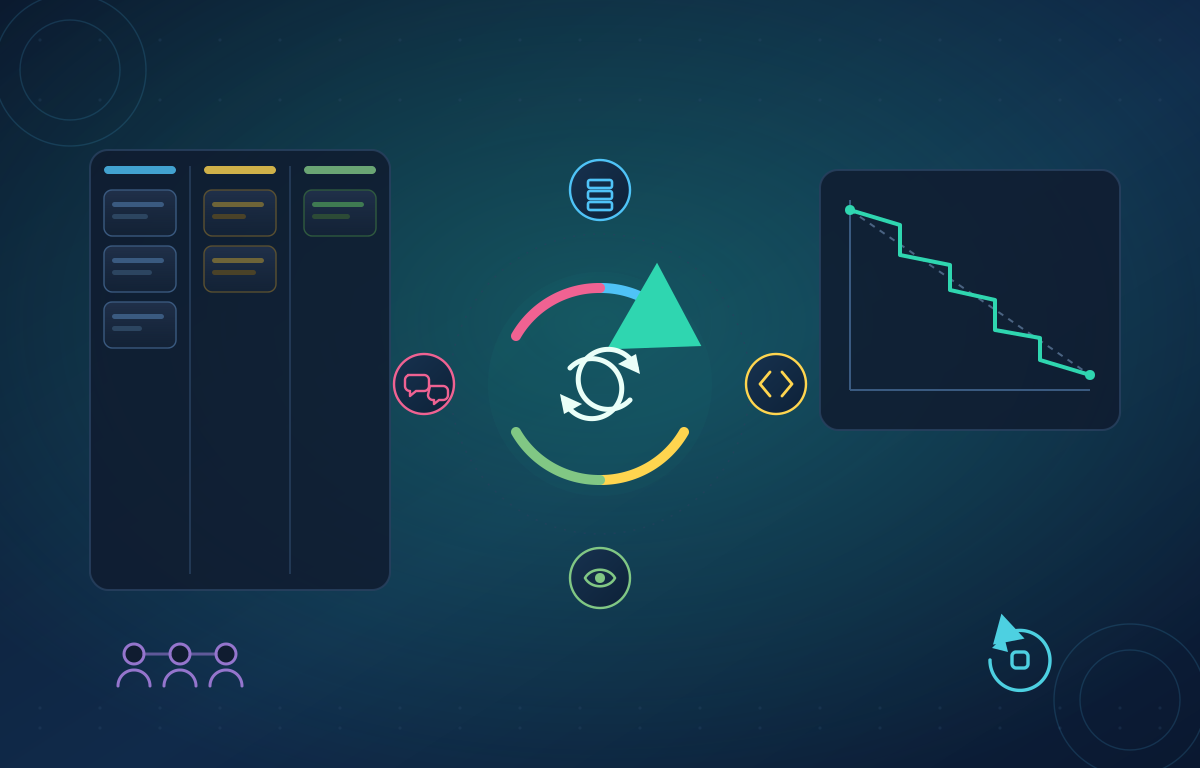
Agile software development adapts to the needs of the business. It is often essential for building an “antifragile” system, allowing the client to see results in the shortest possible time and make adjustments throughout the project. To ensure this approach doesn’t descend into chaos, we employ Scrum—a widely used process framework that aligns with Agile principles while instilling discipline within the team. Our philosophy for implementing Scrum can be summarized as: strict adherence to small-scale rules to enable large-scale flexibility. The framework defines specific roles: the Product Owner, the developers, and—when necessary—a Scrum Master.
If you haven’t worked with Scrum before, we’ll explain how it works.
The Product Owner discusses the scope of work with the client, outlining the path toward the project’s goal. Key milestones are set along this path; upon reaching each one, the client and the Product Owner decide on the best approach for the next leg of the journey. Both the client and the Product Owner follow a shared roadmap, which displays these milestones and the decisions made at each stage.
Based on discussions with the client, the Product Owner creates tasks and estimates them, drawing on their knowledge of the team’s capabilities. Before beginning a new phase of work, the Product Owner and the team review these estimates and task assignments. While the client may provide requirements to the Product Owner in an informal format, the tasks passed from the Product Owner to the developers—via the backlog—are always structured according to the SMART criteria.
The journey between milestones is divided into “sprints.” The Product Owner plans each sprint with the team, the work is executed, and the results are demonstrated to the Product Owner (and the client, if they wish to attend). This is followed by a retrospective and the planning of the next sprint.
If the client is already familiar with Scrum, they may choose to act as the Product Owner themselves. In such cases, we include a Scrum Master on the team to ensure that both sides share a common understanding, setting the stage for collective success.
Agile development is designed for clients who are actively involved in the process. It is not a universal panacea; a more traditional, standard approach—often well-suited for medium to large-scale companies—is always an option.
We maintain process discipline in our Agile development by adhering to official Scrum standards. For the design phase, we typically follow the ICONIX methodology.